Author Topic: Shot heard 'round the world  (Read 4092 times)

kilopaparomeo

  • Top Forum Member
  • *****
  • Posts: 498
  • My own private purgatory...
  • Liked:
  • Likes Given: 0
Re: Shot heard 'round the world
« Reply #20 on: March 30, 2013, 12:44:36 PM »
Part 8-Smith's Column

While Revere was riding west to Lexington, Col. Smith's column was assembling at the water's edge on the south end of Boston. The officers who were present did not know the mission and were only told to get their companies in line but things were not going well. By 10 pm the units that were supposed to being ferried across were still being formed and no progress was being made. Large wooden skiffs were present but there was not enough of them to carry the 700 men across. Col. Smith was not in attendance and arguments broke out among the officers as to who should go first.

The troops had been issued the standard combat load of 36 rounds of ammo for their .75 cal smooth bore Brown Bess, flint lock muskets. They also carried the requisite 18" triangular bayonet, cartridge box and haversack for food and personal items.

Col. Smith arrived near midnight and found his troops still on the eastern shore of the Charles River. He quickly got his officers in order and the troops began moving across. The troops were packed shoulder to shoulder in the low skiffs with water all the way up to the gunnels. Because Gage was so concerned with secrecy, he demanded that the troops be landed at an uninhabited point. Where they landed,  a place called Lechmere Point, was uninhabited because it was  a marsh at high tide. After spilling out of boats, the troopers slogged through cold mucky water up to their waists.

Once ashore it was learned that food rations had not been issued. A call was put out to the navy to bring rations. The navy responded by clearing out their spoiled and rotten supplies which once issued, the soldiers promptly threw them away.

Long after Paul Revere had reached Lexington and the militia turned out, the troops were finally ashore and assembled.  However Smith, known for following orders rather than being a brilliant tactician, spent another hour lining up ther troops in regimental order. 5 hours behind schedule, the orders were given to march west.

to be continued...
    
NRA Endowment Life Member
SAF Life Member
NRA Certified Rifle Instructor
Ultima Ratio Civis - "The last method of a citizen"

kilopaparomeo

  • Top Forum Member
  • *****
  • Posts: 498
  • My own private purgatory...
  • Liked:
  • Likes Given: 0
Re: Shot heard 'round the world
« Reply #21 on: March 30, 2013, 12:55:10 PM »
Part 9-Lexington

Upon reaching Lexington Paul Revere immediately went to the house of Reverend Jonas Clark. He knew that John Hancock and Sam Adams when warned out of Concord a few days before had retreated to Rev. Clark's house. This house was chosen because Hancock's grandfather had built the church and rectory and served as it's minister for many years before Clark took over. Hancock was well known in the town having spent a great deal of time there with his grandfather.

Revere was surprised to be stopped by armed militia men as he approached the house. He was told that earlier in the day 8 men on horses identified as army officers had come through town. John Parker the militia captain had ordered the same number of his men to protect Hancock and Adams.

Revere, Hancock, Adams and Parker met to discuss what to do. Hancock wanted to stay and fight but Adams and Revere talked him out of it. Parker decided he would call out his militia and send scouts east toward Boston to try and locate the column. As they talked, William Dawes, the other rider out of Boston showed up.

After some rest and food, Adams and Hancock were to leave town as soon as possible while Revere and Dawes would continue their ride to Concord.

On the road out of town, Revere and Dawes ran into Dr. Samuel Prescott from Concord. Prescott had been in Lexington visiting his fiance' Lydia Mulligan. Prescott informed Revere that he was "a true son of liberty" and would help spread the word. Since he was doctor he knew most of people in Concord and surrounding areas.

As the trio rode west they noticed a couple riders along the road ahead in the moonlight. Moving forward two more riders appeared from the shadows under the trees. Four more riders suddenly appeared behind them and they realized these men were British officers. Faced with 8 armed men with pistols and nowhere to run Revere and his companions were forced to surrender. The officers, a combination of lieutenants and sergeants forced the men off the road into a stone walled coral. A quick glance among the trio was exchanged and all three spurred their horses forward. Prescott and Dawes managed to clear the wall and escape while Revere's reins were seized by the nearest officer. Revere was caught and ready to pay the price.

continued...
NRA Endowment Life Member
SAF Life Member
NRA Certified Rifle Instructor
Ultima Ratio Civis - "The last method of a citizen"

RTFM

  • Top Forum Member
  • *****
  • Posts: 597
  • NRA Life member 2015
  • Liked:
  • Likes Given: 0
Re: Shot heard 'round the world
« Reply #22 on: March 30, 2013, 07:53:04 PM »


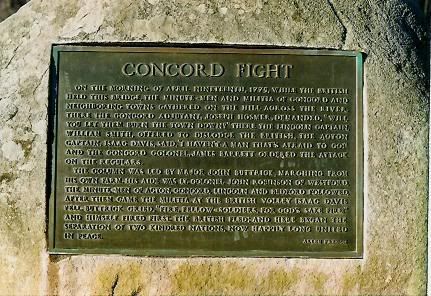
Concord Fight
On the morning of April Nineteenth 1775, while the British held this bridge, the Minute Men and Militia of Concord and neighboring towns gathered on the hill across the river.
There the Concord adjutant Joseph Hosmer, demanded “Will you let them burn the town down?”
There the Lincoln Captain William Smith offered to dislodge the British, the Acton Captain Isaac Davis, said “I haven’t a man that’s afraid to go” and the Concord Colonel James Barrett ordered the attack on the Regulars.
   The column was led by Major John Buttrick, marching form his own farm his aid was Lt. Colonel John Robinson of Westford. The Minute Men of Acton, Concord, Lincoln and Bedford followed. After them came the militia. At the British volley Isaac Davis fell, Buttrick cried “Fire fellow soldiers for God’s sake fire” and himself fired first. The British fled and here began the separation of Two kindred nations now happily long united in peace.
By Allen Freech


Concord Fight small
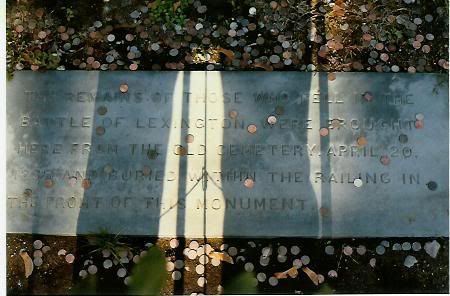
The remains of those who fell in the Battle of Lexington were brought here from the Old Cemetery April 20 1835 and buried within the railing in the front of this monument
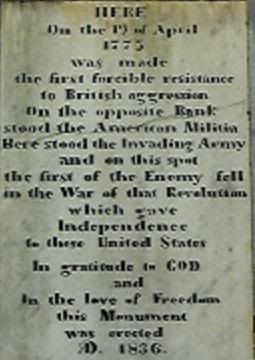


Min Man Mon British
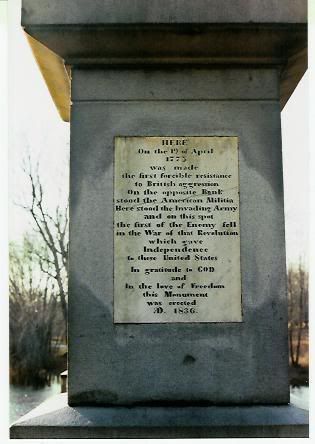
Here on the 19th of April 1775 was made the first forcible resistance to British aggression.
On the opposite bank stood the American Militia.
Here stood the Invading Army and on this spot the first of the enemy fell in the war of the Revolution which gave Independence to the United States.
In gratitude to GOD and in the love of Freedom this monument was erected ad 1836.
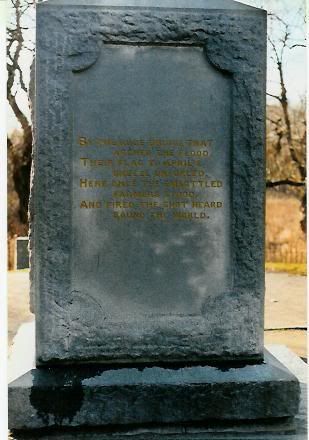


Min Man mon Col side
By the rude bridge that arched the flood.
Their flag to April’s breeze unfurled.
Here once the embattled farmers stood.
And fired the shot heard round the world.
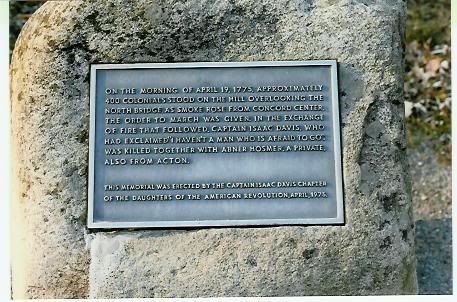


Isaac Davis stone
On the morning of April 19, 1775 approximately 400 Colonials stood on the hill overlooking the North Bridge, as smoke rose from Concord Center.
The order to march was given, in the exchange of fire that followed, Captian Issac Davis, who had exclaimed “I haven’t A man who is afraid to go” was killed together with Abner Hosmer, a Private, also from Acton.

This memorial was erected by the Captain Isaac Davis chapter if the Daughters of The American Revolution, April 1975.
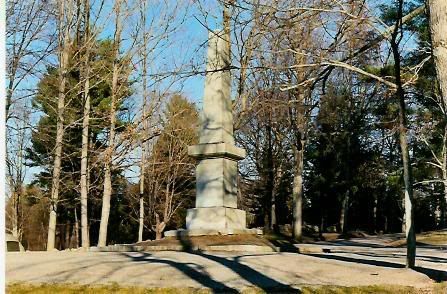
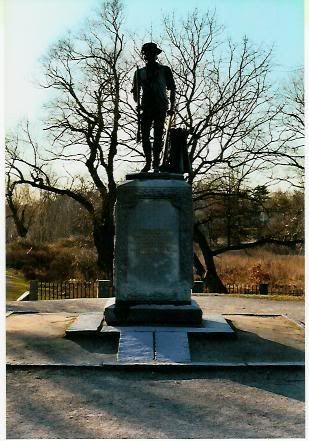


North Bridge Colonial side
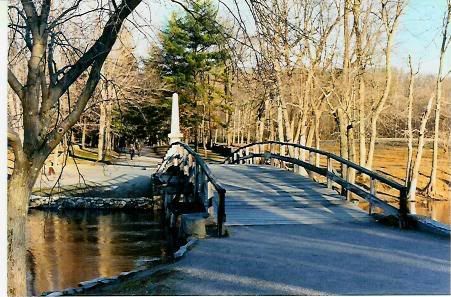


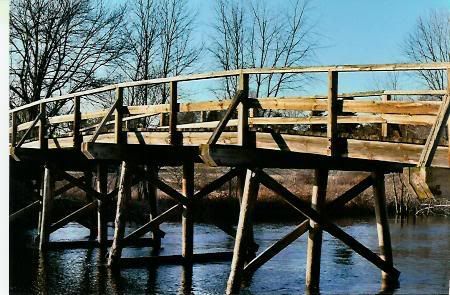
North Bridge Colonial side looking from the meeting point
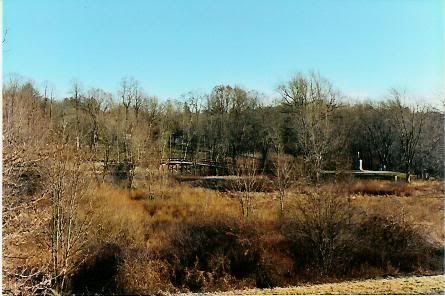


North Bridge from the English side
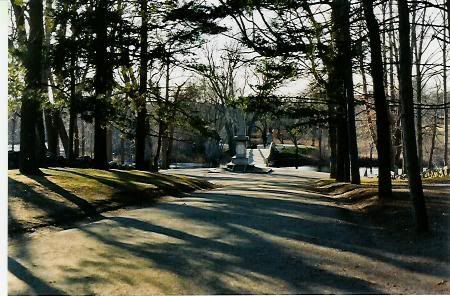


kilopaparomeo

  • Top Forum Member
  • *****
  • Posts: 498
  • My own private purgatory...
  • Liked:
  • Likes Given: 0
Re: Shot heard 'round the world
« Reply #23 on: March 30, 2013, 08:36:21 PM »
Great pix...I'll add some of my own at the end of all this. Hope you guys are enjoying it.


Part 10- The Alarm

Sixteen year old William Diamond lay asleep in his house with his family. He was warm and comfortable under the quilts and blankets huddled together with his brothers and sisters. There was no central heat just a fireplace that had burned down leaving the house cold in the mid April night.

Suddenly he was shaken awake by his mother. "Billy get up, there is trouble in the village, take your drum." He was still groggy when he and his father started the walk through town. He was also cold in the chilly New England air. He noticed that the same full moon that guided Paul Revere across the river earlier in the night was now high in the sky. He could hear the meeting house bell ringing in the distance.

As he and his father walked he noticed other people in the houses moving about in the flickering candle light. He noticed other men and boys moving silently along, the bright dots of candle lanterns swaying as they walked.

One of those boys he saw was Jonathon Harrington. Jonathon was walking with his father and cousin Caleb Harrington. As they reached the town square, known as Lexington Green, his family met at his uncle and namesake's house at the north end of the green.

Prince Esterbrook was already awake in his shack behind the main house when there was a knock on his door. "You don't have to go" his master said. Prince knew the value of freedom by not having any. As a slave he thought maybe these white men might appreciate what they had if it was in danger of being taken away. He had already decided. He would go. "I am ready," he said as he stood.

Captain John Parker was 40ish. He was a veteran of the French Indian War. He had been in Roger's Rangers an elite company for it's time and the forerunner of today's Army Rangers. Parker had been elected captain of the Lexington Militia by his friends and neighbors because of his steady hand, resolute demeanor and experience. He watched the men file by singly or in small groups onto the green. When he saw Billy Diamond and the young Jonathon Harrington he walked over to them. He put a hand on each of their shoulders and said, "I need you boys to stay close to me. Billy, beat assembly to call the men in. When they are formed, Jonathon play something on your fife while we wait for the others."

Diamond the company drummer and Harrington the company fifer did as they were told. Both were only five years old when the trouble started. From the time they could remember all they heard from their elders was about how their liberty was being taken away. They had grown up under the shadow of government oppression and they were both eager to stand up against it no mater what the cost.

As the men and boys formed that day they had no idea what to expect in the coming hours. Standing in armed defiance to the crown was treason. There was no health insurance or life insurance to help their families if wounded or killed. There was no social security or welfare. The death or disablement of the bread winner in the family meant destitution for the whole family. The was no emergency medical service to respond if wounded. There were no anesthetics to dull the pain. There were no antibiotics to prevent infection.

The choice was not simple and it's consequence this day was likely the hot lead of a musket ball, the cold steel of the bayonet or the hangman's noose.

Yet, despite the dangers the women of the town sent their sons and husbands, brothers, fathers and grandfathers. They were as young as 15 years and old as 70. The fathers stood with their sons, nine pairs on the green that morning. Nearly everyone on the green were related either by blood or marriage.

They stood together as one in defense of liberty.


to be continued.
    
NRA Endowment Life Member
SAF Life Member
NRA Certified Rifle Instructor
Ultima Ratio Civis - "The last method of a citizen"

kilopaparomeo

  • Top Forum Member
  • *****
  • Posts: 498
  • My own private purgatory...
  • Liked:
  • Likes Given: 0
Re: Shot heard 'round the world
« Reply #24 on: March 30, 2013, 08:42:20 PM »
Part 11- The Advance

Paul Revere stood in the darkness with 8 officers of the kings army surrounding him. A cocked pistol was pressed to his head and the officer demanded his name.

"I am Paul Revere" he replied. Surprised, the men all looked at each other as if to ask "Paul Revere? THE Paul Revere?"

"Do not lie to us sir, who are you and what are you doing about this eve?" Asked the leader.

"I AM Paul Revere and I beg your pardon." He said disgustedly. "I am taking a message to Concord about the column of troops going there to deprive our countrymen of their rights and arms."

The Lieutenant was startled by this. While he knew a a column was out, he had no knowledge of the mission of Smith's column. His orders were simply to patrol the roads and stop any messengers that might be out. As he pressed Revere for more information Revere readily obliged.

Back in Lexington, Captain Parker had briefed his men on the green. He had sent scouts east to find the column. As the night wore on the men standing in the cool spring air became tired and restless. The initial surge of adrenaline had worn off and many fought to keep their eyes open. No word had yet come back from the scouts about the location of troops.

Out on the road Revere was being pressed for more information. He thought that his only chance was to tell the truth but maybe enhance it a little. He began to tell his captors that they had been watching the troops assemble in Boston and knew from the outset the mission. He explained that by now all the supplies they were after in Concord had been removed and hidden. He told them that he had 500 men in Lexington waiting for Smith, the mission would be a disaster.

Back in Lexington Captain Parker surveyed his men. With no real idea of what was happening he decided to have the men stand down. "Men," he said. "Stand down but stay in town and within the sound of the drum." Many of the men including the Harringtons retreated to Uncle Jonathon Harrington's house on the edge of the green. Others who had come into town from the surrounding countryside were grateful that the proprietors of the Buckman Tavern on the south edge of the green opened its doors to provide food and a chance to warm up. As those men gathered to enter the tavern they unloaded their muskets by firing a volley into the air. The cool damp air worked it's way into the black powder if given a chance. The only way to ensure proper operation was fire the muskets and then reload when the time came to go back out.

Back on the road, Paul Revere was raising the anxiety of his captors with each telling of the massing of the militia. Suddenly as if on cue, a volley if musket fire came from the direction of Lexington. The startled officers suddenly had to make a decision. Do they execute the prisoner, take him with them or ride quickly back to warn Smith of the ambush? An extra horse would be useful if they chose to warn the column and surely they would be forgiven for not bringing the famous Paul Revere if it meant saving their fellow troops.

The decision was made. Revere was left on foot as the officers took his horse and raced east hoping to meet Smith before he got to Lexington.

more later...
NRA Endowment Life Member
SAF Life Member
NRA Certified Rifle Instructor
Ultima Ratio Civis - "The last method of a citizen"

Sponsor

  • Guest
Re: Shot heard 'round the world
« Reply #25 on: Today at 11:31:07 AM »

kilopaparomeo

  • Top Forum Member
  • *****
  • Posts: 498
  • My own private purgatory...
  • Liked:
  • Likes Given: 0
Re: Shot heard 'round the world
« Reply #25 on: April 01, 2013, 04:18:21 PM »
Part 11- The Advance

Paul Revere stood in the darkness with 8 officers of the kings army surrounding him. A cocked pistol was pressed to his head and the officer demanded his name.

"I am Paul Revere" he replied. Surprised, the men all looked at each other as if to ask "Paul Revere? THE Paul Revere?"

"Do not lie to us sir, who are you and what are you doing about this eve?" Asked the leader.

"I AM Paul Revere and I beg your pardon." He said disgustedly. "I am taking a message to Concord about the column of troops going there to deprive our countrymen of their rights and arms."

The Lieutenant was startled by this. While he knew a a column was out, he had no knowledge of the mission of Smith's column. His orders were simply to patrol the roads and stop any messengers that might be out. As he pressed Revere for more information Revere readily obliged.

Back in Lexington, Captain Parker had briefed his men on the green. He had sent scouts east to find the column. As the night wore on the men standing in the cool spring air became tired and restless. The initial surge of adrenaline had worn off and many fought to keep their eyes open. No word had yet come back from the scouts about the location of troops.

Out on the road Revere was being pressed for more information. He thought that his only chance was to tell the truth but maybe enhance it a little. He began to tell his captors that they had been watching the troops assemble in Boston and knew from the outset the mission. He explained that by now all the supplies they were after in Concord had been removed and hidden. He told them that he had 500 men in Lexington waiting for Smith, the mission would be a disaster.

Back in Lexington Captain Parker surveyed his men. With no real idea of what was happening he decided to have the men stand down. "Men," he said. "Stand down but stay in town and within the sound of the drum." Many of the men including the Harringtons retreated to Uncle Jonathon Harrington's house on the edge of the green. Others who had come into town from the surrounding countryside were grateful that the proprietors of the Buckman Tavern on the south edge of the green opened its doors to provide food and a chance to warm up. As those men gathered to enter the tavern they unloaded their muskets by firing a volley into the air. The cool damp air worked it's way into the black powder if given a chance. The only way to ensure proper operation was fire the muskets and then reload when the time came to go back out.

Back on the road, Paul Revere was raising the anxiety of his captors with each telling of the massing of the militia. Suddenly as if on cue, a volley if musket fire came from the direction of Lexington. The startled officers suddenly had to make a decision. Do they execute the prisoner, take him with them or ride quickly back to warn Smith of the ambush? An extra horse would be useful if they chose to warn the column and surely they would be forgiven for not bringing the famous Paul Revere if it meant saving their fellow troops.

The decision was made. Revere was left on foot as the officers took his horse and raced east hoping to meet Smith before he got to Lexington.

more later...
NRA Endowment Life Member
SAF Life Member
NRA Certified Rifle Instructor
Ultima Ratio Civis - "The last method of a citizen"

kilopaparomeo

  • Top Forum Member
  • *****
  • Posts: 498
  • My own private purgatory...
  • Liked:
  • Likes Given: 0
Re: Shot heard 'round the world
« Reply #26 on: April 01, 2013, 04:19:05 PM »
Part 12-The Challenge

Col. Smith's troops had reached Menotomy (modern day Arlington) just a few miles from Lexington when 8 of his officers rode up. Smith called a halt while he listened to them explain that they had caught Paul Revere and that there was 500 militia in town. No, they hadn't seen them themselves because they had taken a wide berth around Lexington to avoid detection but they had heard the musket fire and the bell ringing the alarm.

Smith's troops themselves had heard bells in each town they passed through. They had heard shots off in the distance alerting the country side as they marched. He knew that there presence was known but was sure the colonists didn't know the purpose.

Turning to Major Pitcairn, his second in command, Smith ordered his royal marines to the head of the column. Pitcairn's marines, essentially light infantry, were to proceed as fast as they could in advance of the main body to Concord and carry out the mission.

As the marines advanced on Lexington, Capt. Parker was suddenly made aware of one of his scouts returning to town. The scout reported that he had been trapped behind the column in Cambridge and only managed to get around them when they stopped in Menotomy. He reported that they were only a mile or so out and moving fast. Parker immediately ordered young Diamond to beat assembly. The men filed out of their houses and the Buckman Tavern and formed up again at the west end of the green.

About this time Paul Revere walked into town from his ordeal on the road. Talking to Capt. Parker he was shocked to learn that Hancock and Adams were still in town. Revere immediately ran to Rev. Clark's house and confronted the reluctant Hancock who wanted to stay and fight. Revere explained that if he was killed or captured it would be devastating blow to the cause. He must leave, NOW!

Hancock finally agreed to go. Urged on by Sam Adams they packed up and headed north out of town. Revere stayed behind and learned from Hancock's male secretary that all the papers from the provincial congress were in a trunk and still in his room at the Buckman Tavern. If those papers fell into the hands of the army, the cause and many people associated with it would suffer terribly. Revere determined to save the trunk.

Lexington Green is a triangular shaped space about 100 yards long and 50 yards wide at it's north west end. The narrow point is toward the east where the meeting hall stood. The road from Boston split at the meeting hall. The right fork going past Buckman Tavern across the street from the hall and continuing at a north west angle skirting the green. The left fork swung straight west to Concord.

Parker's men in the meantime were formed at the wide end of the green. They were nervous and uneasy, not knowing what to expect. A few grumbled about how it wasn't worth it and talked about leaving. Parker said, "the first man to leave will be shot dead." These were his own friends and family standing with him. Most of them knew he meant it. The fear of Parker humiliating them and perhaps shooting them in front of their families was worse than the fear of the redcoats. They remained steadfast.

As the dawn broke the sounds of many men on the road to the east became apparent. Revere and Hancock's secretary had reached Buckman Tavern and were wrestling with the heavy trunk. Jonathon Harrington's cousin Caleb, John Simmons and another man were on the second floor of the meeting house watching as the royal marines came into view on the road to the east.

Major Pitcairn had put one of his firebrand lieutenants at the head of his column. Lt. Jesse Adair rode ahead and noticed men at the far end of the green in the early morning light. His mission was to go to Concord but he was itching for a fight and wanted to teach these insolent farmers a lesson. As his men reached the fork in the road he made a fateful decision to confront the men on the green. He lead his two hundred men onto the right fork and then onto the green. He immediately formed them into battle lines.

Paul Revere had seen the approach of the marines. He and Hancock's secretary barely got out the back door of the tavern when the marines spilled past them intent on forming on the green. Staying behind the tavern, he made his way behind the buildings skirting the road to the treeline as the troops formed their ranks.

Seeing the ranks of soldiers spilling onto the green, the 70-80 man militia heavily outnumbered, took an involuntary step backward. Capt. Parker shouted to his men, "Stand your ground men. Do not fire unless fired upon, but if they mean to have a war, let it begin here!"

to be continued...
NRA Endowment Life Member
SAF Life Member
NRA Certified Rifle Instructor
Ultima Ratio Civis - "The last method of a citizen"

kilopaparomeo

  • Top Forum Member
  • *****
  • Posts: 498
  • My own private purgatory...
  • Liked:
  • Likes Given: 0
Re: Shot heard 'round the world
« Reply #27 on: April 01, 2013, 04:19:49 PM »
Part 13-The Fight

Capt. Parker's men watched the redcoats form into battle formation some 70 yards away, their bayonets glinting in the early morning light.

Major Pitcairn riding up from the column and swinging his pistol rode half the distance to the militia. He shouted at them "lay down your weapons, ye villains, ye rebels, lay down your arms and disperse!"

Capt. Parker had made his point. Vastly outnumbered he turned to his men and told them to disperse. At the same time a shot rang out. Paul Revere would later testify that it sounded like a pistol shot as he retreated with the trunk of papers. Others reported it came from the side of the green from behind a wall. A loud sharp sound in an open space surrounded by buildings often bounces around making it hard to pinpoint. No one knows who fired that first shot but it is clear who fired the first shots. Without orders, the front line of the regulars opened up in an ragged volley. The second line advanced and poured a full volley into the militia as they scrambled away.

Most of the men wounded were shot in the back. Jonas Parker, Capt. Parker's uncle took off his hat, threw it on the ground with his flint and ball. He defiantly stood his ground yelling "I shall not run". He was immediately knocked down by a musket ball. Prince Esterbrook was also knocked down latter to be helped off the field.

The troops with their blood up ignored orders and charged the militia with the bayonet. Jonas Parker was bayoneted to death as he lay on the ground trying to reload his musket. They continued after all those who ran.

Jonathon Harrington the fifer's uncle and namesake was shot in the back as he retreated. He rose back to his feet and collapsed again. Crawling on his hands and knees he made his way to the edge off the green. Falling into the arms of his horrified wife on their doorstep, he died as his children watched from the doorway.

At the other end of the green, Caleb Harrington, the fifer's cousin and John Simmons were caught in the meeting hall as the redcoats swarmed on to the green. When the troops charged they attempted to make a run for it. They were seen by soldiers who fired upon them. Caleb was shot down and killed as he ran. Simmons was forced back into the meeting hall where he barricaded the door. The soldiers who fired upon him pounded on the door trying to gain entry. Simmons knew that if they entered they were likely to find the town's black powder supply stored on the second floor. He ran up the stairs as the troops broke down the front door and started searching for him. Picking up his musket, he thrust the muzzle into one of the barrels of powder. "They will pay a heavy price for the powder today" he said to himself as he cocked the hammer and said a prayer.

The soldiers on the green still out of control were hunting down anyone they could find. Col. Smith back in the main column rode to the sound of the fighting and was shocked to see his troops rampaging through the town ignoring their officers. He quickly grabbed a drummer and had him beat to assembly. The men, more out of conditioning than duty began to respond.

Back in the meeting house the soldiers reached the bottom of the stairs. John Simmons closed his eyes and began to squeeze the trigger. As they began to climb the stairs they heard the beat of the drum. Conditioned to react to the drum and without further thought, the soldiers wheeled around and exited the meeting house angry that the rebel they had chased into it would slip through their fingers.

It took some time for the troops to reassemble. Their blood lust was up and they were reluctant to stop. Col. Smith finally got them into order and calling upon his officers told them the mission.

Many of the officers realized that they had just fired without orders. They knew that their men had gone out of control and they would be held responsible for the deaths. There would be courts-martial and trials. The countryside would be up in arms over this atrocity. They had another 8 miles further west to travel and another 18 miles back to Boston though hostile territory. To continue would be folly.

Col. Smith looked past the officers to the men. He and they were still charged up for the fight. He listened to the arguments of his officers and clearly stated that the mission would continue. Turning back to the men, he ordered three HUZZAHS and a volley of musket fire to celebrate the victory. Forming back into column they began the march west to Concord.

Continued....
NRA Endowment Life Member
SAF Life Member
NRA Certified Rifle Instructor
Ultima Ratio Civis - "The last method of a citizen"

kilopaparomeo

  • Top Forum Member
  • *****
  • Posts: 498
  • My own private purgatory...
  • Liked:
  • Likes Given: 0
Re: Shot heard 'round the world
« Reply #28 on: April 01, 2013, 04:21:20 PM »
Part 14- The Aftermath

Capt. Parker stood looking at the dead and wounded. He looked past the green to the houses and the heard the lament of the women and families who lost loved ones. He saw the women scurrying about taking anything of value and burying it in their gardens. They knew that the column had continued west and would come back through Lexington. They knew there would be reprisals against the town for standing up to the king's troops. They knew there would be pillaging and plundering.

Parker also knew that if he didn't hide the bodies of those who were slain, the army would dig them up, and hang them out of spite as a warning. His men would take the dead to the edge of the burial grown and dig a ditch. They would bury the dead including his uncle Jonas in the ditch and then cover the grave with leaves, branches and brush to hide it. He knew that the fight wasn't over and he began to prepare to avenge the attack on his town.

Young Jonathon Harrington couldn't stop crying. He had lost his uncle and his cousin. He had seen his friends and neighbors shot down. Of the 9 sets of fathers and sons on the green, 5 were separated by death.

The day had just begun. No one knew what would transpire that day or how it would end. They did know that by standing up for their liberty the spark of revolution had been lit.
NRA Endowment Life Member
SAF Life Member
NRA Certified Rifle Instructor
Ultima Ratio Civis - "The last method of a citizen"


SMF spam blocked by CleanTalk