Darth Deadfish Rahm, pales in comparison to Goebells
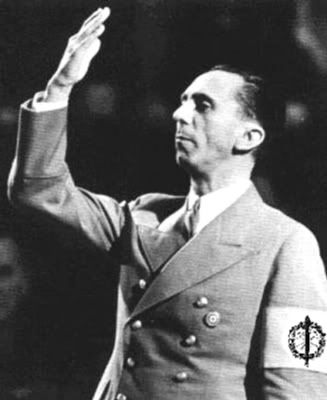
You think Carl Rove or Rahm is "respectable"?
We can discuss Woodrow Wilson, and his "model" for propaganda, that was "respected" by Goebells further along.... 
Respect is a "tricky" word. It involves removing one's personal opinion, and simply looking at a given task with an ultimate end.
The PC folk won't get it., just ask Juan Williams...
Exactly my point TW

FQ, I'll give you Johnson, he got through everything Kennedy couldn't by being an arm twister. But Alinsky himself never got any one elected, although any one who has an interest in politics should pretty much live by his "Rule's for Radicals".
As for the Spanish war, that was more due to the sensationalism of Pulitzer and Hearst. Hearst is often quoted as telling Fredrick Remington "You supply the illustrations, I'll supply the war."
Your "Mark Hanna" is not to be found here.
http://en.wikipedia.org/wiki/Spanish%E2%80%93American_WarIf any one in government should get credit for, as you put it, "ginning up the war with Spain", it would be a Jr. Asst. Secretary of the Navy who among other steps relocated the US Asiatic squadron to Hong Kong, and got an aging Commodore named George Dewey appointed to it's command.
As for the rest, Nixon was OK, but he got caught, Lee Atwater, Dana Carville and Carl Rove are just based on your liberal prejudice.
And just what is wrong with political violence ? For a political Science professor you are sure naive.
The trick is knowing when and where to apply violence, Burning the Riechstag just before the election, very smart, New Black panthers in front of polling station, in the day of video and camera phones it is very dumb.
As for you boy Hanna,
http://en.wikipedia.org/wiki/Mark_HannaManager of campaigns
Hanna made a transition into politics during the 1880s, and in 1888, he managed Ohio Senator John Sherman's unsuccessful effort to gain the Republican presidential nomination. Rep. William McKinley had tried unsuccessfully to win the position of Speaker of the House in 1891, losing to Rep. Thomas B. Reed of Maine, who was backed by Theodore Roosevelt. McKinley then turned his attentions to running for governor of Ohio. Hanna helped McKinley win the 1891 and 1893 elections for governor and became his chief advisor.
McKinley's strongest competitor for the Republican nomination in 1896 was Speaker Reed. After Hanna attended a speech Reed gave in Washington, he realized that Reed lacked the presidential appearance or stature McKinley possessed. After McKinley won the 1896 Republican nomination for president, Hanna, as chairman of the Republican National Committee, raised an unprecedented $3.5 million for McKinley's campaign,
in which he ran on the gold standard, high tariffs, pluralism, and renewed prosperity. Most of the money came from corporations who feared that William Jennings Bryan's Free Silver policy would limit their economic power. By October the Democrats realized they were losing the battle for campaign funding and targeted Hanna as the arch-villain who threatened to put corporate interests ahead of the national interest.[5] As McKinley was highly likeable, Hanna became a target of Bryan's supporters, especially William Randolph Hearst and his New York Journal.
Hanna's campaign employed 1400 people, who concentrated a flood of pamphlets, leaflets, posters, and stump speakers. McKinley defeated Bryan by an electoral vote of 271 to 176. At the time, it was the most expensive campaign ever in U.S. politics, with the McKinley campaign
outspending Bryan's by nearly 12 to 1. Today it is considered the forerunner of the modern political campaign for its adroit use of publicity, its overall national plan, its strategic use of issues, and especially the candidate's own speech making.


 MBTV
MBTV Forum Index
 Help
Help Calendar
 Contact Info
 Register as a member
